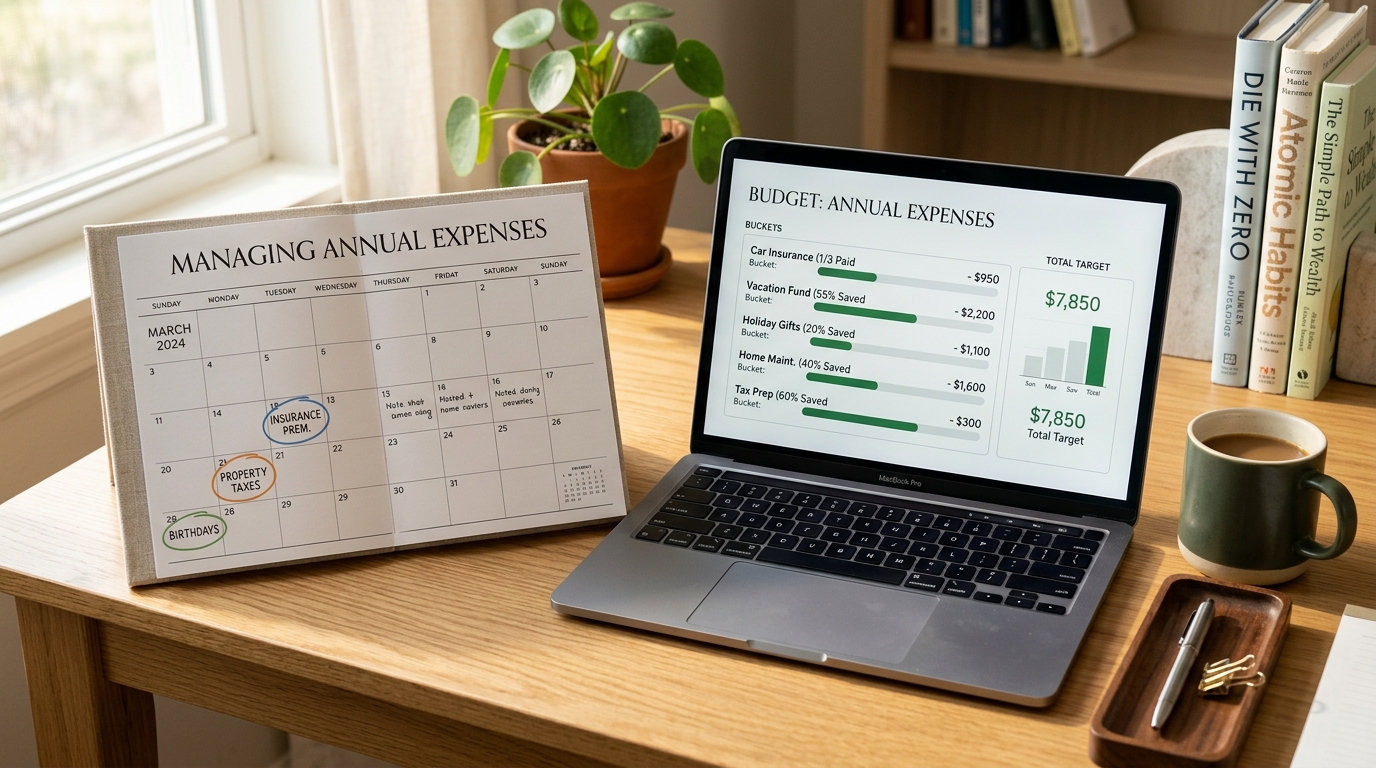
You check your bank account on a random Tuesday and the balance is far lower than expected. A quick scroll reveals a 487 dollar charge from your auto insurer or a 1,200 dollar property tax payment you knew was coming but forgot to reserve cash for. Monthly cash flow looked steady, yet a bill paid only once or twice a year derailed everything.
Why Monthly Budgets Fail by Default
These irregular costs are ghost bills: annual, quarterly, or semi-annual obligations that seem totally predictable in hindsight but feel like ambushes when they hit your account. Common examples include vehicle registrations, insurance premiums, municipal property taxes, homeowners association dues, and annual software subscriptions. They are not true emergencies. They are ordinary living expenses that happen on a non-monthly schedule.
The root problem is simple. A budget built exclusively around 30 day cycles is structurally incomplete. Suppose you bring home 5,000 dollars monthly and list 4,600 dollars in regular monthly bills. On paper, you appear to have a 400 dollar surplus. If you also carry 7,200 dollars in annual and quarterly expenses across the year, that equals another 600 dollars per month you never factored in. Your budget was never 400 dollars ahead. It was 200 dollars in the red every single month.
The Three Part Ghost Bill Blueprint
To eliminate irregular bill panic forever, apply a three part framework: audit every non-monthly obligation, automate monthly sinking fund transfers so cash sits ready before the due date, and negotiate the underlying rates so you stop overpaying.
Step 1: Audit Every Ghost Bill on Your Calendar
You cannot solve a problem you cannot measure. The opening step requires building an exhaustive list of every expense that does not post monthly.
Avoid guessing from memory. Open your banking and credit card statements covering the previous twelve months. Filter for transactions appearing quarterly, semi-annually, or annually. Build a checklist containing:
State registration tags, emissions testing, annual parking permits, and bi-annual auto insurance.
County real estate property taxes, annual homeowners or renters policies, and quarterly HOA assessments.
Quarterly estimated IRS or state taxes, professional licenses, gym dues, and yearly digital subscriptions.
Annual medical deductibles, routine dental cleanings, back to school supplies, and year-end holiday spending.
Record the exact dollar amount and the specific month each item is due. When numbers vary year to year, always round up to build a natural safety cushion.
Step 2: Calculate Your True Monthly Baseline
Once you compile the master list, translate each annual or quarterly cost into an equivalent monthly sum.
You are not creating new expenses. You are smoothing out the timing of money you already spend. The vendor may only collect payment once a year, but your household enjoys the service every day.
Step 3: Automate the Sinking Fund System
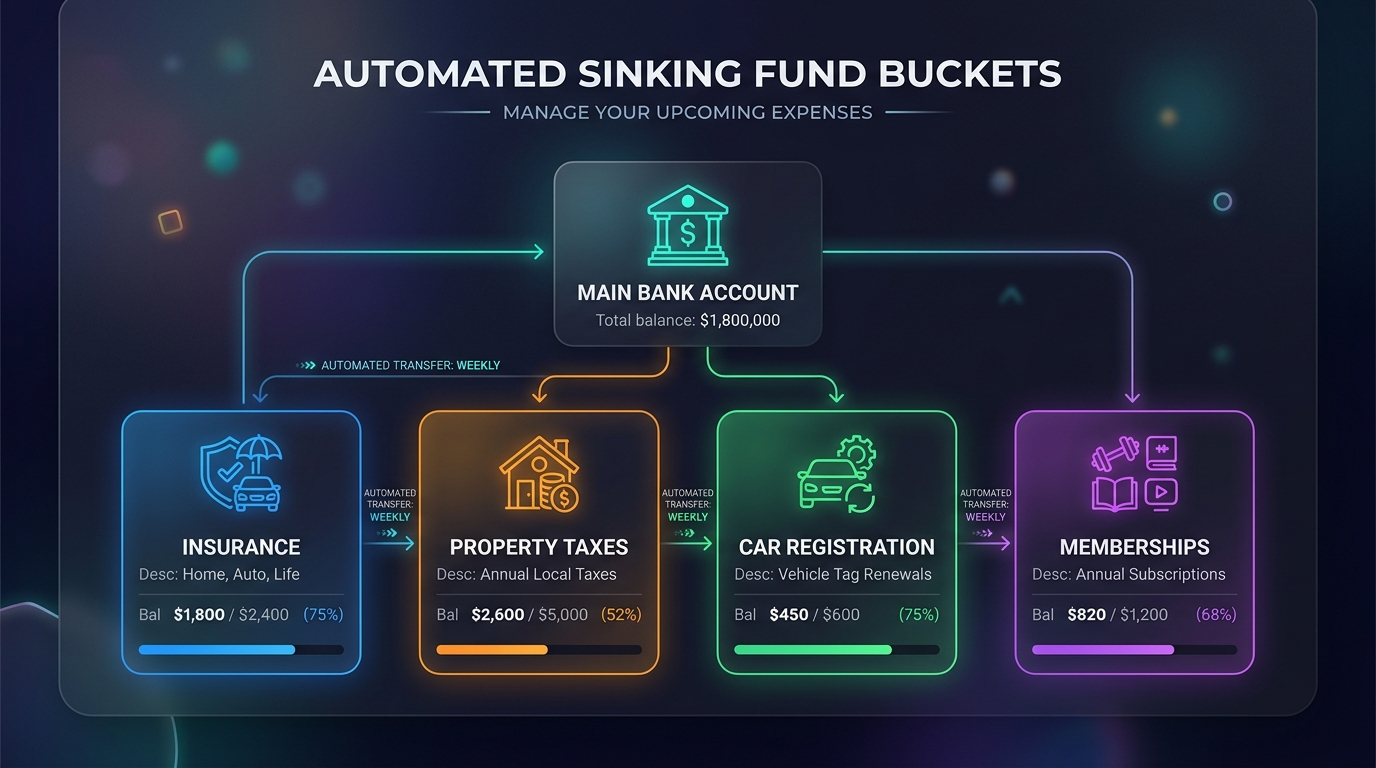
Calculating the numbers on a spreadsheet is only the foundation. Cash must physically accumulate in a dedicated account before bills post.
Establish a high yield savings account separate from your everyday checking account. Many modern institutions allow you to partition balances into sub-accounts or digital savings buckets. Configure an automated recurring transfer from your checking account to your ghost bill bucket scheduled for the day following your primary payroll deposit.
This digital envelope method ensures money leaves your primary checking account before discretionary spending occurs. When an annual property tax or insurance bill arrives, transfer the exact balance back to checking and pay in full without touching your emergency reserves or carrying a credit card balance.
Many auto insurers and municipal utilities offer monthly installment plans. While installments feel convenient, providers often tack on administrative convenience fees ranging from 3 to 10 dollars per transaction, or cancel upfront pay in full discounts worth up to 10 percent. Paying a 1,200 dollar annual policy across monthly installments frequently ends up costing 1,320 dollars. Always evaluate the full annual cost before choosing installment billing.
Step 4: Actively Re-Shop and Negotiate Rates
Funding your reserve accounts handles half the challenge. The second half is shrinking the baseline cost of every vendor on your list.
Insurance policies represent your biggest dollar savings opportunity. Gather quotes from at least three competing carriers with identical liability limits and deductibles. Call your current carrier with competitive rates in hand. Use this exact phone script:
"I am currently conducting our annual household budget review and reviewing competing auto policies. My current renewal rate is noticeably higher than quotes I have received for the exact same coverage limits. Before I switch carriers, I want to review any unapplied discounts on my profile, including low annual mileage credits, defensive driving verification, and updated occupational tiers. What is the most competitive rate you can apply to keep my policy active?"
This script applies equally well to internet providers, home insurance, and mobile phone plans. Customer retention teams have discretionary promotional credits that front-line representatives never publish online. You simply need to request them with real market data.
Essential Gotchas to Avoid
An unexpected engine transmission failure is an emergency. A vehicle registration tag due every November is not an emergency. Tapping your emergency fund for predictable calendar dates depletes your safety net and distorts financial planning.
A 9 dollar monthly cloud storage upgrade or a 99 dollar annual fitness app appears harmless in isolation. Combined, dozens of micro-subscriptions quietly siphon over 1,200 dollars annually. Run a complete statement audit every six months and cancel recurring accounts unused for over 30 days.
If your monthly cash flow feels tight after funding your ghost bill bucket, that reveals critical information: your baseline lifestyle costs more than your monthly bills suggested. Discovering this early in the year gives you time to trim discretionary spending rather than panicking when property taxes arrive.
The Bottom Line
Struggling with annual bills is not a personal failure. It is an artifact of outdated monthly budgeting models. Human memory is not built to track costs that show up once a year. The solution is building an automated banking framework that does the remembering for you.
Compile your master expense schedule. Divide each total by twelve. Automate recurring transfers into a dedicated savings bucket. Re-shop your policies annually. Once this rhythm is established, ghost bills will never surprise your household again.
Continue The Ghost Bill Series
Take control of each specific irregular expense category with our complete tactical playbooks:
- Slashing Your Electric and Gas Bills in 2026: Time of use strategies, smart upgrades, and utility rate structure audits.
- The Water Bill Survival Guide: Silent leak detection, tier avoidance, and utility adjustment credits.
- The Car Insurance Negotiation Playbook: Step by step re-rating scripts and discount stacking.